In compliance, you quickly learn that the real challenge isn’t the lack of data—it’s the lack of clarity. There are client files, KYC records, transaction logs, risk assessments, audit trails… but they often sit in silos. You spend more time navigating systems than actually understanding risk.
At some point, I wanted to change that—at least for myself.
During my MBA in Business Analytics, I learned how to frame business problems into data models, KPIs, and decision-ready dashboards. So, as a leisure project, I decided to build an interactive compliance dashboard in Tableau. Not just something visual, but something practical. Something that reflects how compliance work actually happens day to day.
This project became a natural extension of my journey—combining what I learned during my MBA in Business Analytics with my experience as a compliance executive. The goal wasn’t academic. It was simple: if I had one screen to understand my entire compliance universe, what would it look like?
You can explore the dashboard here: https://complywithja.pro/dashboards
Starting with the Right Data (Without Using Real Data)
One of the first challenges was data. Real compliance data is sensitive, and rightly so. To work around this, I used data generated through AI to simulate realistic scenarios—clients across jurisdictions, different entity types, varying risk ratings, stakeholder structures, transaction flows, and KYC gaps.
Interestingly, this gave me more flexibility than real data ever could. I could shape scenarios intentionally—introduce high-risk clusters, simulate FATF changes, or create KYC deficiencies—to test whether the dashboard actually surfaces what matters.
From Static Reports to a Fully Active Dashboard
What I didn’t want was another static report. Compliance already has enough of those. So I focussed on making the dashboard fully active—something you can explore, question, and interact with. Every chart connects to another. Every filter changes the story. You can start from a high-level overview and, within a few clicks, land on a specific client, transaction pattern, or missing document.
It’s designed to feel less like a report—and more like a workspace.
Understanding the Client Base (Client Overview)
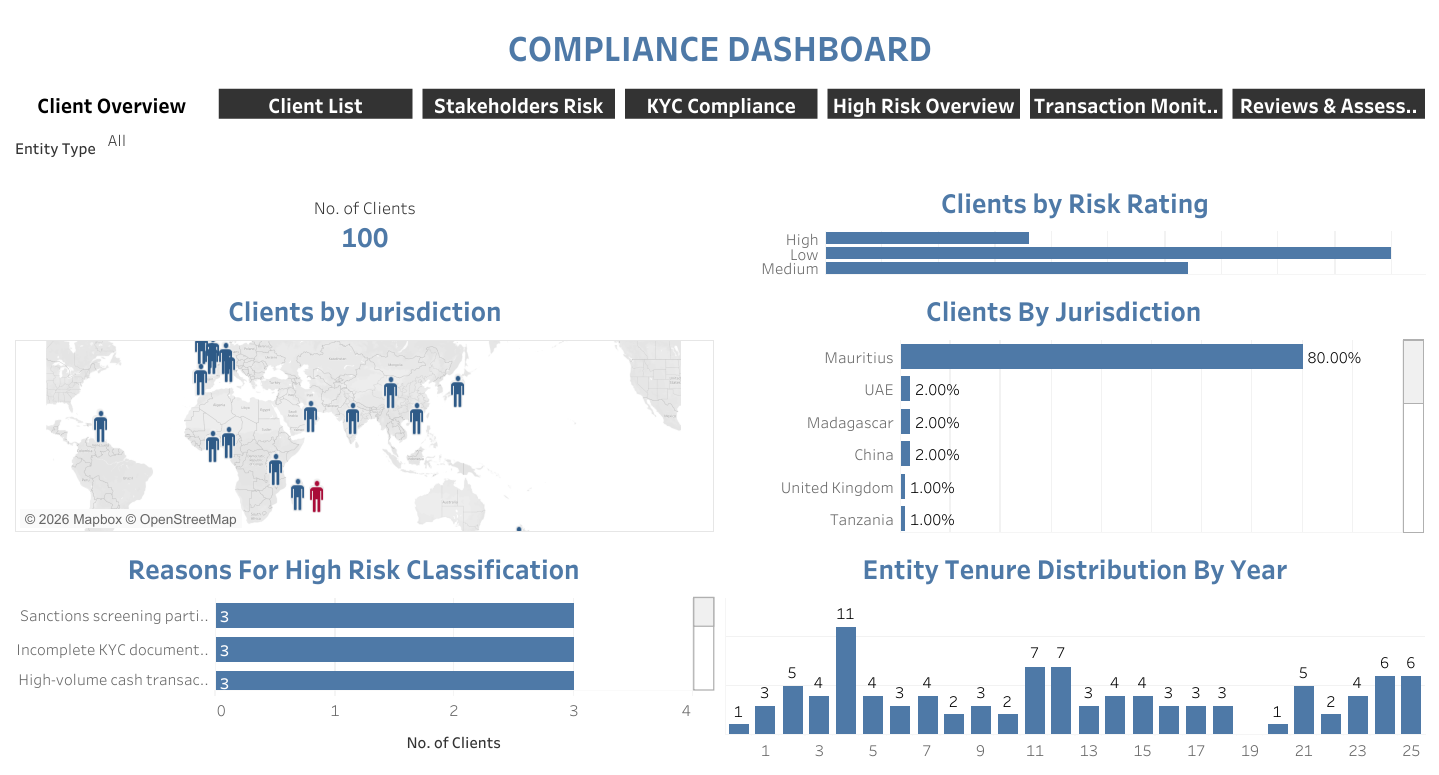
I started with the foundation: the clients. The Client Overview gives a snapshot of the entire portfolio—how many clients there are, how they’re distributed across entity types (ACs, GBCs, Trusts, Foundations, domestic companies), and where they are incorporated. But more importantly, it doesn’t just show how many are high risk—it shows why they are high risk.
That distinction matters. A number tells you scale. A reason tells you what to do next. Adding dimensions like risk rating distribution and entity tenure helped bring context—are newer entities riskier? Are certain structures overrepresented in high-risk categories?
Moving from Overview to Action (Client List)
Once you see the big picture, the next question is always: who exactly are these clients? That’s where the Client List comes in. It acts like a working register—fully filterable by status (active, inactive, dormant), risk rating, country of incorporation, entity type, and even incorporation year ranges.
This is where the dashboard becomes operational. You’re no longer looking at charts—you’re identifying specific populations to review, investigate, or escalate.
Risk Isn’t Just About Entities (Stakeholders Overview)
In compliance, entities rarely act alone. The real risk often sits behind them. The Stakeholders Overview shifts the focus to individuals—highlighting high-risk stakeholders, their countries of residence, and nationalities. It also surfaces how many entities are exposed to these individuals.
This is particularly useful when entity-level risk appears moderate, but underlying stakeholders introduce elevated exposure.
The Reality of Compliance Work (KYC Gaps)
No matter how well systems are designed, KYC gaps happen. Documents expire. Information goes missing. The KYC Compliance section brings that reality into focus—showing missing and outdated KYC, gaps in Source of Funds and Source of Wealth, and even identifying shareholders with missing documentation.
But more importantly, it provides detailed lists—not just metrics. Because knowing you have 50 missing KYC files isn’t helpful unless you know which 50.
High Risk, But Contextual (FATF and EDD Views)
The High Risk Overview pulls together everything you’d expect from enhanced due diligence—PEPs, adverse media, high-risk stakeholders, and affected entities. One feature I found particularly important is the FATF period parameter.
Compliance is not static. A jurisdiction flagged in 2024 may no longer be listed in 2025. With this parameter, the dashboard dynamically adjusts residency-based risk views depending on the selected FATF period. So the same dataset can tell a different story depending on the regulatory context applied. That’s the kind of nuance that’s often missing in traditional dashboards.
Following the Money (Transaction Monitoring)
Of course, no compliance view is complete without transactions. The Transaction Monitoring section looks at flows from multiple angles—payments vs receipts, monthly trends, transaction categories, currencies, and geographic flows (remitter and beneficiary countries).
It also goes a step further by highlighting control gaps—transactions where supporting documents are missing or screening wasn’t performed. That combination—behaviour + control failure—is often where the real risk sits.
Keeping Track of What’s Due (Reviews & Assessments)
Finally, I wanted a clear view of compliance obligations—because risk isn’t just about clients, it’s also about whether we’re doing what we’re supposed to do. The Reviews & Assessments section tracks annual reviews and Customer Risk Assessments (CRA)—what’s pending, what’s completed, and how this breaks down by risk rating and over time. It answers a simple but critical question: are we keeping up?
Built for Curiosity, Useful in Practice
I built this dashboard as a leisure project—out of curiosity, and honestly, because I enjoy this kind of work. But the outcome goes beyond that. It can be used to analyse a wide range of compliance-related areas: client risk exposure, stakeholder-driven risk, KYC deficiencies, FATF-linked jurisdictions, transaction monitoring insights, and operational backlogs.
More than anything, it shows what happens when you bring together analytics thinking and compliance experience.
Final Reflection
This project was more than just a technical exercise in Tableau; it was an attempt to bridge the gap between "having data" and "having intelligence." In the compliance world, we often drown in registers and spreadsheets, yet we struggle to answer simple questions about cumulative risk. By building this from scratch, I wanted to prove that when you apply an analytical lens—informed by an MBA in Business Analytics—to the everyday realities of a compliance executive, you can transform a compliance function from a reactive cost centre into a more proactive, insight-driven unit.
That said, the dashboard is far from perfect. There are still areas I would like to refine and expand. For instance, some risk scoring elements could be made more dynamic and weighted rather than static classifications. The transaction monitoring section could benefit from more advanced anomaly detection or scenario-based alerting logic (for this specific part, I definitely do not have the knowledge to do it myself yet—I suspect I would need AI for that one). There is also room to improve automation, such as real-time data integration instead of simulated datasets, and more seamless linking between KYC deficiencies and remediation workflows. Even the user experience could be enhanced further with guided navigation or alert prioritisation layers.
BUT that is exactly the point.
This dashboard represents a foundation—a working model of what compliance analytics can look like when realised with both business understanding and analytical thinking. It shows that even with limitations, it is possible to move away from fragmented reporting and toward a more connected, exploratory, and decision-oriented approach to compliance.
And in many ways, that shift in mindset is more important than perfection.